Showing posts with label Fish. Show all posts

May 19, 2017

Shui Zhu Yu, 水煮鱼 Sichuan Boiled Fish

Last week, my husband, an avid pescetarian, bought a whole Lapu-lapu (grouper) that was 10 kgs. (Yeah, surreal!)  As I was still banned from kitchen duty having been only a week post-surgery, the Lapu-lapu was cooked the way those who were cooking knew how. 

Now my husband has a favorite Sichuan fish stew, called Shui Zhu Yu, 水煮鱼. for which I found a recipe at chinasichuanfood.com.  As he was traveling to China, I asked our friend there for help with the ingredients, and my husband took them home to me.  Ang dami!


This is only half of the stash that our good friend bought for me, as there wasn't enough space in my husband's luggage for it. The rest would have to come on his next trip to China. To think I was only asking for a pack each!

Anyway, so I got all excited and tried making Shui Zhu Yu 水煮鱼 last night, following the recipe I found to the letter.

How did it go?


Not bad for a first time, it was delicious, but lacking the oomph of the authentic dish. Usually the dish is really spicy, heavily laden with peppercorns and dried Sichuan peppers, so I was surprised that the recipe called for very little. It wasn't as spicy as the one I had in Guangzhou, and it wasn't as red and inviting.  I was actually a tad disappointed, parang palpak. :) Di bale, I will put an entire pack of chilis and heaps of the doubanjiang next time.  

Usually this stew is also very oily, because the last step involves about half of a cup of oil and pouring it over the stew. Here's how it should be according to my recipe source:


I decided to use less oil.  Maybe that also made the difference?

Since I followed recipe to the letter I will no longer post it here.  I will try making it again with tweaks and when I succeed making it as authentic-tasting and authentic-looking as it should be, I'd post my recipe.

May 16, 2017

Escabeche (Sweet and Sour Fried Fish)


Growing up as a child of the Martial Law years and into the recession of the '80s, I grew in a mindset of cost-cutting and zero wastage, especially when it comes to food.  The downside of that was, sometimes we'd think we'd never see the end of a particular food (especially if there'd been a lot of leftovers); the upside was that this made us resourceful and creative especially in giving food some bagong-bihis.  I've carried the habit over the years, and I always pore through the contents of my refrigerator for what I can put together into a "new" dish before I even take something out of the freezer.

This dish is one of such 'upcycled' ones. :)

ESCABECHE

What's In It?

Leftover fried fish (preferably fleshy ones like dalagang bukid, alumahan, hasa-hasa)
3-5 T cooking oil
2 T peeled and sliced ginger
3 cloves garlic, peeled and mashed
1 large scallion/red onion, peeled and sliced
2 finger chilis, sliced into rounds
1/2 teaspoon ground black pepper
3/4 c water
2 T brown sugar
2 T fish sauce
1/3 c white or cane vinegar

Kitchen Conjugations:

In a wok or deep pan, heat oil.  Reheat left-over fried fish until crispy.  Remove from heat and transfer onto serving dish.  Set aside.

Onto the waiting hot oil, add in ginger, and let fry in hot oil for half a minute.  Add in red onions and stir fry for another half minute.  Add in garlic and finger chili and continue sautéing for  15 seconds.

Pour in brown sugar and fish sauce and stir to combine.  Add in water.  Let boil then pour in vinegar. DO NOT STIR. Let mixture boil then lower heat to simmer for 3 minutes.  Check seasonings, add sugar or fish sauce or ground black pepper or vinegar, to achieve the right balance of sweet-sour-salty and spice.

Remove sauce from heat and pour over fried fish. Serve hot with steamed rice.  Enjoy!

=====

PS:

1.  Some opt to add the fried fish into the simmering sauce to allow the fish to absorb the taste of the liquid. For me this makes the fish soggy, which I don't like, so I opt to pour the sauce right before serving.  But of course you can always have it either way. :)

2. It is important NOT TO STIR vinegar when it has not yet boiled, as otherwise it will taste raw.


Mar 13, 2014

Angel Hair with Sea Bass Mediterraneo


Given the chance, my husband will always eat fish. Even when eating out and presented with various entrees, he will choose fish, or that which has fish in it.

At Italianni's, his staple fare is Sea Bass Mediterraneo, pan-seared Sea Bass put on top of pasta, usually angel hair.  He was saddened to find then, when we lunched at the restaurant over the weekend that the dish has been taken out of the menu.*

To cure his hang-up and to assure him that it isn't the end of the world yet, I tried replicating Sea Bass Mediterraneo at home. Judging from his grin I think I've guessed the ingredients and procedure pretty
well. :)

ANGEL HAIR WITH SEA BASS MEDITERRANEO

What's In It?

For the pasta:
500 grams Angel Hair pasta, cooked according to package directions
1/2 cup olive oil
5 cloves garlic, peeled and minced
1 large red onion, peeled and sliced
3 ripe tomatoes, seeded then diced
1/8 cup capers (in vinegar)
1/4 cup green olives, pitted then sliced into rounds
3/4 cup white wine


For the fish:
1-2 slices Sea Bass, halved
1 teaspoon fine salt
1 teaspoon ground black pepper
1 teaspoon garlic powder (optional)
1/2 cup olive oil

Kitchen Conjugations:

Season the fish with salt, black pepper and garlic powder (if using).  Set aside.

In a non-stick skillet heat olive oil over high heat. Add seasoned bass slices and sear for 1 minute per side or until edges turn light brown.  Remove from pan and transfer onto a plate.  Repeat until all fish slices have been seared.

Lower heat then add olive oil to start the saute.  When oil is hot enough, saute the onions until soft, then add in the garlic.  Stir fry for 30 seconds, and add in the diced tomatoes, olives and capers. Stir fry for about half a minute before adding white wine. Let boil then reduce heat to simmer for a minute or two.

Adjust seasonings by adding salt and pepper if needed. Then toss in the cooked angel hair and continue to toss to distribute the sauce for another 30 seconds.

Remove from fire, transfer angel hair onto a serving plate and top with the seared Sea Bass.
Mangia Bene!

-------------------

*We asked the manager why they took the dish out of the menu. She said it was because "Sea Bass is an endangered species." Really? We wager that the real reason was that the dish wasn't as popular as the other items and was costlier to produce/keep in the menu.


Mar 6, 2014

Fish and Tofu Hotpot ala Ho Chai Lai


There's a Chinese restaurant along the National Highway in Muntinlupa City that enjoys a good following despite its 'barest essentials' positioning because of the taste and quality of their food.  Ho Chai Lai is almost always packed at lunch time, frequented by people who want Chinese fare beyond the usual dimsum and Filipinized offerings at Chowking.  Their bestseller is the Stuffed Squid, squid stuffed with chives, battered, deep fried and served with a special sauce on the side.

When we dine at Ho Chai Lai, my husband and I usually order the Stuffed Squid and this dish, Fish Head Eggplant Hotpot, or the other variant, Fish Tofu Hotpot. My husband likes it so much I've taken it upon myself to replicate it at home, and merging the two variants eggplant and tofu, so that my husband gets the best of both and enjoy the dish whenever he wants. :)

The most recent appearance of this dish on our dinner table was two Thursdays ago, when we had friends over for dinner. I was surprised to find my meat-loving friends loving it, even asking for the recipe. So here it is!

FISH, EGGPLANT AND TOFU HOTPOT

What's In It?

For the Fish:
1.5 kgs Bitilla* (White Snapper, see photo), gutted, descaled and sliced into serving portions
1/2 cup all-purpose flour
2/3 cup water
1 tsp. + 1/2 tsp. fine salt
1 tsp. + 1/2 tsp. finely ground black pepper
1 cup cooking oil, for frying

For the hotpot:
1/4 cup cooking oil, for sauteing
1 large thumb ginger, peeled and sliced in rounds
1 large red onion, peeled and sliced
5 cloves of garlic, peeled and mashed
6-8 large pieces of dried Shiitake mushrooms, soaked in 1 cup warm water for 30 minutes or longer
1 1/2 cups water
1/2 cup oyster sauce
1 Knorr fish broth cube
1/2 cup brown sugar
1/2 cup Chinese cooking wine
2 tablespoons sesame oil (optional)
3 tablespoons cornstarch, dissolved in 1/4 cup water
3 stalks onion leeks, sliced, white part separated from greens
2 medium eggplants, peeled, halved lengthwise then crosswise
half a large block of tofu, cut into 1" squares

Kitchen Conjugations:

Prepare the Fish: Season the fish slices with a teaspoon each of salt and pepper. In a shallow bowl, make a thin batter of the flour, water and season it with 1/2 teaspoon each of salt and pepper.  Set aside.

In a wok or frying pan, heat the cooking oil over medium heat. Test if cooking oil is hot enough by dropping bit of the batter, watching for sizzling. When the oil is hot enough, carefully drop the fish slices one by one, leaving enough space between each slice to prevent them from sticking with each other. (Turn heat to high as oil temperature has dropped with the addition of the fish. Turn settings back to low when the oil begins to sizzle again.)  Fry the fish slices for about 3-4 minutes each side or until they turn light brown. Remove from the pan and transfer onto a plate. Do the same process for the rest of the fish until all have been cooked.

Make the hotpot: In a hotpot or saucepan, saute the ginger, onions and garlic in hot oil. Stir fry for about a minute, then add in the oyster sauce. Stir fry for about half a minute, then add all ingredients except the eggplant, tofu, leeks and cornstarch slurry. Let boil then simmer for a minute.  Check and adjust seasonings, adding sugar, salt or the cooking wine to produce a balance of sweet, salty and tangy.

Add the eggplant slices and let the sauce simmer until they are half-cooked. Then add in the white parts of the leeks, the tofu squares and fried fish slices. Let boil then simmer for about two minutes, before adding the cornstarch slurry to thicken the sauce.

Garnish with the rest of the onion leeks and serve with steamed rice.  Enjoy!

----------
*Other fish like Maya-maya (Red Snapper), Lapu-lapu (Grouper) or Labahita (Surgeonfish), may also be used.  You can also use fillets, but make a thicker batter (that of pancake batter consistency).

---------
UPDATE:  I've replaced the original photo with a new one, this time made more colorful by the addition of carrot medallions. I've also cut the tofu into bigger squares and pre-fried them to make them easier to handle. The fish used in the dish in the picture above is lapu-lapu.


May 4, 2013

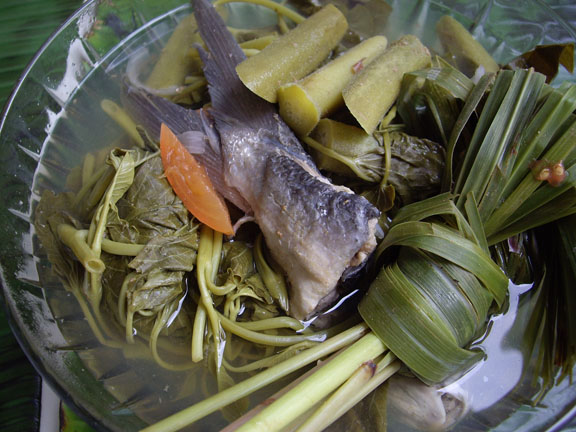
Linagpang Nga Turagsoy


Seventeen years of marriage not only transformed me into a fish and veggie-lover, it also opened me to the Cebuano way of cooking.  Which is a good thing, actually, because I easily tire of eating the same things, and I like seeing, tasting and cooking a variety of dishes.

Almost 4 years ago when we vacationed in my husband's hometown in No. Cotabato, we had this soup during one of the lunches and I immediately got hooked.  When I asked what it was, they told me it was Turagsoy.

Back in Laguna weeks later, I hankered for the delicate interplay of spice, saltiness and the smoky flavor imparted by the Inihaw na Dalag. So I begged my husband to please find me a dalag, so I can make this soup. I got my wish. :)  I made Turagsoy according to how I imagined it to have been done, based on the tastes I remembered. 

However, while I came up with something good, I knew there were some flavors lacking and I knew I had to get the recipe and make the real thing.  Luckily I eventually had the chance to ask the then-appointed cook, my brother-in-law, who happily gave me the recipe. I realized later though that the recipe he gave me is large enough to feed a large family of 10-12 people, maybe because my husband's family is large. Tee-hee. :)

Wanting to find out more, I tried googling Turagsoy and that's how I found that Turagsoy is actually the Ilonggo term for dalag (haluan in Cebuano), and that this soup is actually an Ilonggo dish called Linagpang nga Turagsoy.  


Linagpang/Nilagpang, according to MyFilipinoKitchen is grilled meat soup. It is similar to the Cebuano tinuwa and the Tagalog pesa, but it requires any meat to be put in the soup (fish, chicken or pork) to be grilled first and is spicy.

LINAGPANG NGA TURAGSOY (Grilled Mudfish in Soup)

What's In It?

2 pcs. (approx. 1.5-2 kgs.) mudfish, cleaned  
1 large piece (approx 1 kg) milkfish, cleaned
rock salt
6-8 pieces tomatoes
2 large onions, peeled
5 stalks onion leeks, sliced into 2" lengths
1/2 to 1 hand ginger, peeled and sliced into thin rounds
2 large red bell peppers
4-5 bird's eye chili
shrimp paste, to taste
2 liters drinking water

Kitchen Conjugations:

Season the mudfish and milkfish with salt then grill them over hot charcoal until juices run clear. Grill tomatoes and bell peppers until slightly wilted.  

Remove any charred portions from the fish', tomato and pepper skins. Slice bell peppers onto bite-size chunks. Cut the fish into smaller portions. Set aside.

In a small bowl, mash grilled tomatoes with the bird's eye chilies (if using).  Set aside. 

Boil water over high heat.  Add in the sliced onions, ginger and bell pepper in a large saucepan and simmer for 5-10 minutes.  Add in fish slices, let boil then simmer for 10 to 15 minutes.

Season with the mashed tomato-chili mixture and bagoong or uyap,  Add green onions and/or leeks.
Let boil for about 1-2 minutes more, then check and adjust seasonings if needed.

Serve with rice.  

--------
Notes:

1. Local names:  Dalag/Turagsoy/Haluan (mudfish), Bangus (Milkfish), Alamang/Uyap (Shrimp paste), Labuyo (Bird's Eye chili)

2. Dalag is NOT hito (catfish).  Hito has a leaner body than dalag and has more bones making it less suitable for this dish (it is better crispy fried or grilled).   

3. The pictures above were taken when I cooked this dish yet without the recipe from my brother-in-law.  That explains why the tomatoes appear sliced/quartered in the picture instead of mashed.

4. Some recipes do not call for the tomatoes nor the bell peppers to be grilled. I think that's okay, but grilling the vegetables imparts more flavor and therefore adds dimension to the soup so I'd go with grilling the vegetables too.

Jul 16, 2008

Bangus Steak / Bangus Bistek


While pregnant with Mika bangus (milkfish) was one of the things I always craved. I had it inihaw, sinigang, prito and of course, Filipino bistek style.

Many people I know do not like eating bangus because it's so fussy to eat, having lots of bones to pick. But did you know that for a small charge (P20.00) you can have your suki fish vendor debone your bangus? And of course boneless bangus is available in supermarkets, some of them already marinated/seasoned, some of them in fillets (belly and back). For this recipe I used back fillets bought from the South Supermarket. People say I am strange for liking the flesh better than the (more flavorful) belly, but hey, to each his own! :P

BANGUS STEAK / BANGUS BISTEK

What's In It?
1 pack SeaKing Bangus Back Fillets, about 450g.
1/2 t salt
1 c cooking oil
1/3 c soy sauce
1/8 c calamansi juice (squeezed from 6-8 med.-sized calamansi)
1 1/2 c water
3-4 T sugar (I prefer brown/washed)
1 med. onion, peeled and sliced into rings
6 cloves garlic, peeled and mashed
1 t ground black peppercorns

Kitchen Conjugations:
Heat oil in a frying pan over medium heat. Fry bangus fillets until golden brown and a little crisp.

While waiting for bangus to fry, in another pan or wok, saute onions and garlic for 2 minutes or until onions become soft and translucent. Remove some of the onions from pan and set aside to use as garnish later.

Stir in sugar, peppercorns, soy sauce and water. Let boil and simmer for one minute. Pour in calamansi juice but DO NOT stir until after the mixture boils. Simmer for 3 minutes. Taste and adjust seasonings. (You may want it to be on the sweeter or more sour side.) Remove from heat and set aside.

Arrange cooked bangus in a semi-deep dish and pour soy sauce-calamansi mixture. Garnish with the onion rings and serve with hot, steaming rice.

======

Substitution notes:
1) You can always use bone-in bangus, bangus belly and other fish for this recipe. Tanigue, alumahan work just as well.
2) No fresh calamansi? Use 1/2 teaspoon Knorr Sinigang sa Calamansi mix. :)

Oct 10, 2007

Cajun River Cobbler

Another find we had at South Supermarket is the River Cobbler, in fillets. River Cobbler is the commercial name given to Tra, a variety of Vietnamese catfish (the other being Basa). In the US, River Cobbler is marketed as China Sole. (Info source: here and here.)

Anyway, River Cobbler, despite being catfish, tastes nothing like our local catfish hito. It has a delicate texture and nice, white flesh. Judging by the taste, size and appearance, I think it's the same fish used by Fish and Co. for their fish and chips. If you've had that, you know the flesh is juicy and tasty, the stuff fish-lover dreams are made of. :)

This River Cobbler though wasn't deep-fried but turbo-broiled wrapped in aluminum foil. The cajun seasoning gives the broil an interesting kick -- not really spicy but not actually tame, and the mix of herbs and spices (cayenne pepper, black pepper, onion powder, garlic powder, chili powder, thyme, sweet basil and bay leaf) just adds dimensions of taste and aroma to the dish. I think this makes a nice Friday night dish, a great way to end the monotony of the usual dishes of the week.

There are many commercially available cajun seasonings, like McCormick Cajun Seasoning which I used here, but you can also make the seasoning from scratch (recipe here).

CAJUN RIVER COBBLER

What's In It?

1 pack River Cobbler Fillets (about 500g.), thawed
1 1/2 teaspoon salt
1 pack McCormick Cajun Seasoning

Kitchen Conjugations:

Wash the fish fillets and drain over wire racks. Combine salt with cajun seasoning, then rub over both sides of the fillets. Wrap fillets in aluminum foil, leaving some air pockets between the top side of the fillets and the foil (to allow steam to circulate and prevent burning/drying).

Carefully place over wire racks in the turbo broiler and broil for 15 minutes at 180 to 200C.

Serve with blanched/buttered vegetables.

PS: If you're partial to frying, you can opt to cut the fillets lengthwise into halves, dip them in eggwash (1 beaten egg + 3 tablespoons water) then deep fry for 3 minutes or until golden. Drain excess oil from the fillets then coat with the cajun seasoning.

Sep 13, 2007

Sinuglaw na Bariles


Among Cebuanos, tuna is referred to as bariles, the vernacular for water drum. Bariles because the body of one adult tuna is so huge, the diameter could be as round and large as a water drum. Could be as heavy, too. The average bariles weighs about 50 kilos!

And now, a short narration from my husband, who was born and bred in North Cotabato:

"Ang GenSan (Gen. Santos City, South Cotabato), highway ng tuna. Doon dumadaan ang tuna papuntang Pacific Ocean. Sa dami ng tuna na dumadaan, puedeng magtago ka na lang sa bato, pagdaan ng tuna, sapakin mo sa panga!"

Hahahahaha! Maybe that's where Manny Pacquiao trained early on. :)

Anyway, the tuna used in this recipe is from GenSan, one of his pasalubongs from his latest homecoming. Usually sinuglaw uses tilapia, but since we had frozen tuna belly we used that instead.

SINUGLAW NA BARILES

What's In It?

  • 500g tuna belly, sliced diagonally into 4-5 large chunks
  • 1 large onion, peeled and sliced
  • 5 cloves garlic, peeled and minced
  • 1 knob ginger, peeled and sliced
  • 3 to 5 pieces siling labuyo
  • 2 bunches pechay, washed and bottoms removed
  • 1 cup tap water
  • 1/4 cup white vinegar
  • 1/4 cup fish sauce
  • 1 tsp black pepper corns, ground coarsely
  • 1 cup coconut cream (kakang-gata)

Kitchen Conjugations:

Line a deep pan or sauce pot with the onions, garlic, ginger slices and sili. Top with the tuna belly chunks. Pour in water, fish sauce and vinegar. Sprinkle with black pepper corns. Cook over moderate heat. DO NOT STIR until the mixture boils.

Add in coconut cream and stir a little to allow the ingredients to meld. Turn down heat and let the mixture simmer for 3 minutes or until the sauce gets reduced a little. Top the mixture with the pechay leaves, cover and let simmer for one minute, or until the leaves sweat. Remember to keep the leaves crisp and green.

Serve hot with steamed rice, and some fried tuna belly if desired:

Jan 25, 2007

Ginisang Munggo and Prinitong Bugyo

"Ano ho'ng tawag, diyan?"
"Bugyo. Flying fish."
"Ano ho'ng luto diyan?"
"Paksiw. Saka prito."
"Sige, pabili nga ho ng kalahati. Pero wag n'yong putulin yung nguso, para makita ng mga anak ko."

I do not trust myself with buying fish. Checking for freshness, what's good for what isn't exactly my forte, and so it is my husband who buys fish. But it isn't always that I see this fish at the wet market in Pacita Complex, and I knew the find would be news to my husband:

"Wow! Saan ka nakakuha niyan?"
"Sa Pacita. Ano'ng tawag sa inyo nito?"
"Bangsi. Flying fish yan e."
"Sabi nga sa akin."

And so he fried up the bugyo/bangsi/flying fish while I cooked up the monggo.

I remember the story of one classmate who, according to lore, sauteed monggo beans straight up -- sans pre-broiling-- and invented the first ever chunky Monggo Guisado. I heard of one story too where another beginner made ginisang monggo with what seemed like a balde (pail) of sabaw. And so while I trust you are all adept *kitcheners,* (kusineras -- hehehe) I'd have to post the recipe for those who need a tip or two.


Tip #1: To save on gas and to shorten cooking time, wash then soak monggo beans in water for at least 30 minutes before boiling. You can do the soaking in the same pot where you intend to boil the beans. (Better if you can soak for 2 to 3 hours prior.)

Tip #2: Boil the monggo beans to soften them before sauteeing. If you've soaked the beans for at least 30 minutes, boiling time would be about 15-20 minutes. The beans are soft if the seed coat separates from the seed.

Tip #3. Do NOT boil monggo seeds in your pressure cooker.

Tip #4. They MULTIPLY exponentially. So do not cook a lot unless you intend to eat monggo for one whole week or feed a whole baranggay. One cup (about P10.00) feeds 6 to 8.

Tip #5. To pre-boil the beans, use 4 cups of water for every cup of monggo beans.

Tip #6. The green ones work best. Although some swear by the yellow ones. As for me, the red variety is strictly for hopia. ;)


GINISANG MUNGGO

What's In It?

3 T cooking oil
1 large onion, peeled and sliced
1 medium ripe tomato, washed and sliced
5 cloves garlic, minced
1 cup (about 80 g.) green monggo, pre-boiled
50g. hibe (dried shrimps), optional
50g. pork pigue, diced*
2 to 3 pcs. tinapa (smoked fish), scaled and flaked
4 to 5 cups water
1 bunch ampalaya (bitter gourd) tops, washed, leaves separated from vines (optional)
patis (fish sauce) to taste

Kitchen Conjugations:

Heat oil in a wok or deep pan. Saute onions, garlic and tomatoes for one minute. Add in pork and stir fry until lightly browned. Stir in hibe, tinapa, pre-boiled monggo beans and patis. Cover and simmer for 5 minutes over low fire.

Add in water and let simmer for another 5 minutes to allow the ingredients to meld. Top with ampalata tops and let simmer for half a minute or until the leaves change color. Serve with fried fish and steamed rice.

---------
*or use 1 pork broth cube or 50 g. chicharon

Jan 16, 2007

Pescado Grande with Tausi (Fish with Salted Black Beans)

I'M ALIVE!

After 10 years (tee-hee-hee), I'm back in blogging form. Not to spoil the surprise, but let me say there'd be changes in this blog soon, and this post will be among the few of the 'old school'. Let's enjoy it while it lasts. :)


First off for this year is a fish dish, payback for all the crimes committed during the holiday season. :)

Here's the fish: a fairly large one. As I write this, my husband is in China and isn't around to identify it for me, so for the moment let's call it Pescado Grande. :) We bought it at the Arranque Market for P250 per kilo, and I think it weighed in close to 2 kilos. That's a broadsheet newspaper it's lying on, and it occupied 2/3 of the sheet. Pretty big, huh?

Anyway, after the descaling and slicing into more manageable slices, Mike fried Pescado Grande and I took it from there. Recipe below. I'm scaling it down to a more manageable size for you who are not too much into fish eating. :)

FISH WITH SALTED BLACK BEANS

What's In It?

500g. to 800g. fried fish*
3-5 T cooking oil
2 T tausi (salted black beans)
3 T ginger, peeled and sliced into thin strips
1 red onion, sliced
5-6 cloves garlic, minced
1/2 c to 3/4 c water
3 -5 T brown sugar
3 t cornstarch dissolved in 5 t water

Kitchen Conjugations:

Lay fried fish/fish slices on a serving platter.

Heat cooking oil in a wok or frying pan. Saute ginger, onions and garlic until onions are translucent, about 2 minutes. Add tausi and stir fry for 30 seconds before adding water.
Let simmer for 3 minutes. Adjust seasonings by adding a pinch each of salt and pepper, then stir in cornstarch mixture. Let simmer for a minute or so or until the sauce thickens.

Pour over the fish slices and serve immediately. Garnish with chopped spring onions or wansoy if desired.

-----------
*Fried tilapia, labahita, bangus, dalagang bukid, bisugo, maya-maya will work just as well.

Dec 1, 2006

Sinigang na Bangus with Tanglad


Rainy and windy (albeit stormy) weather is always good for one thing -- hot broths. Bulalo would have been nice, but my, the cholesterol! So we opted for Sinigang na Bangus.

As in all broths and stocks, the best flavor comes from the bony parts -- the bone marrow makes bulalo savory, the buto-buto or ribs makes Sinigang na Baboy flavorful. For fish sinigang, well, I believe the head and the tail are the best parts. (Reserve the belly for frying. Make it crisp and wow -- you've got the best combination!)

Anyhow, I discovered SeaKing's Bangus head and tails pack in Shopwise. The pack, which costs P30.00 max, is all head and tails, 500 grams. Throw in some veggies and you have soup for 8! Great, di ba? The tanglad was thrown in for flavor, but go ahead without it and you'd be okay. :)

SINIGANG NA BANGUS WITH TANGLAD

What's In It?

500 g. Bangus, head and tails

1 teaspoon salt

1 large red onion, peeled and quartered

1 large or 2 medium ripe tomatoes, quartered

1 knob ginger, peeled and sliced diagonally

juice of 8 calamansi or 1 pack Knorr Sinigang sa Calamansi mix

1 bunch tanglad (lemongrass), about 8 stalks

8 to 10 cups rice washing, or tap water

2 bunches kangkong, leaves separated from stalks

1 bundle okra, sliced diagonally into 2" pieces

2 teaspoons salt or fish sauce

Kitchen Conjugations:

Wash head and tails and season with 1 teaspoon salt. Set aside.

In a saucepan, boil water/rice washings with the onions, ginger, tomatoes and tanglad. Add in okra and fish when water comes to a rolling boil. Simmer for 2 minutes then season with calamansi and salt or fish sauce. Simmer for another 2 minutes, then add in kangkong. Leave to boil for another minute then remove from heat. Adjust seasonings if necessary, then serve.

Tanglad is usually removed before serving, but I always leave it in for drama. :)

Jul 19, 2006

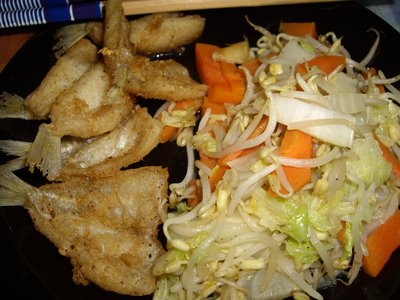
Turbo-Fried Boneless Asuhos and Vegetables

Yet another stab at weight-loss: rice less meals, fiber from veggies and using less oil.


We found the boneless, headless asuhos at the frozen section of SaveMore supermarket in Alabang, at a reasonable P134 per kilo (considering it's been cleaned and deboned).
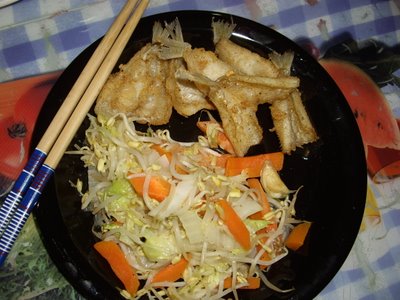
After thawing they were washed and rolled in a mixture of cornstarch, ground black pepper, a pinch of salt and a dash of garlic powder. I brushed them with olive oil and broiled them (using a turbo-broiler) at 250C for about 15 minutes.


The stir-fry is made up of bok choy (Baguio pechay), mongo sprouts and a few strips of red bell pepper, flavored with onions and garlic and a teeny-weeny pinch of salt. If you're not as sodium-conscious you can throw in a dash of oyster sauce. (For a little kick, throw in a dash of hot pepper sauce if you like.) By the way, I stir-fried these in extra virgin olive oil for about one and a half minutes.

----------

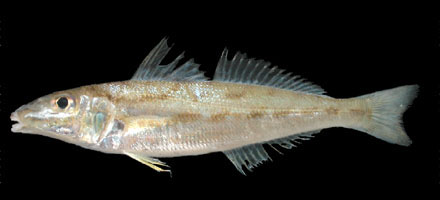
This is Asuhos, before getting caught, bought, cleaned and deboned. It also goes by the name Oriental Sillago.

Apr 23, 2006

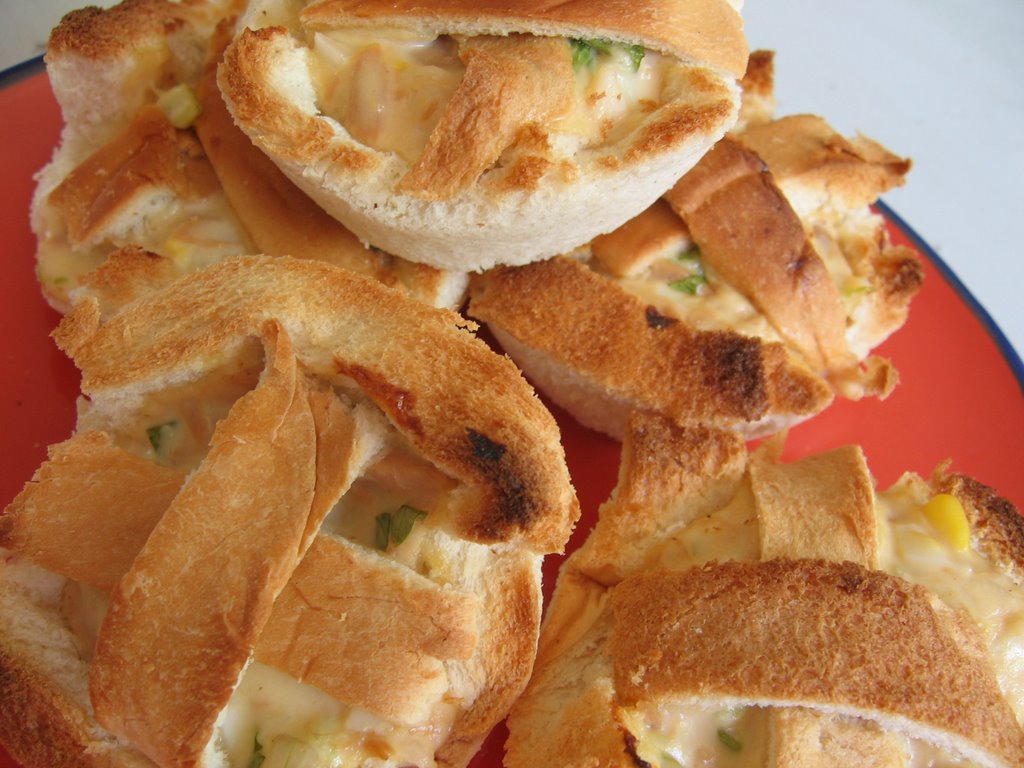
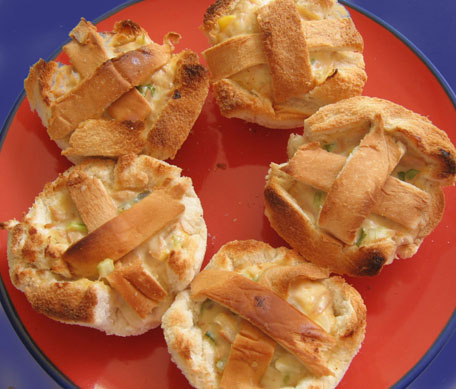
Tuna Egg Ramekins


Something that's fancy enough but quick and easy to do, to serve with coffee for when you have unannounced company, or if you, like me, have kids who clamor for something to do in the kitchen. :)

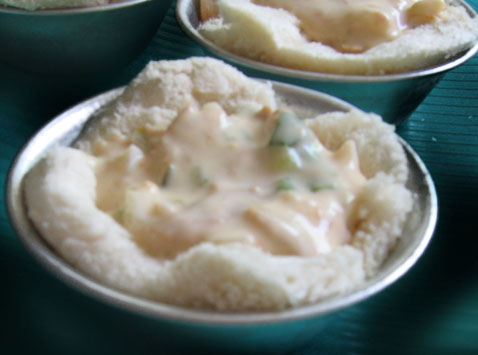
The recipe has two parts: making the Tuna-Egg Salad, and assembling the "crust." The tuna-egg salad doubles as spread for other sandwiches, or as in this recipe, can be served ramekin way.

TUNA-EGG RAMEKINS

What's In It?

  • 3 medium eggs, boiled and diced
  • 1 stalk celery, washed and diced (optional, but a quick way to sneak in some veggies!)
  • 2 cans tuna flakes in vegetable oil, drained (I use Hot and Spicy for a little kick)
  • 1 small onion, diced
  • 1.5 cups sandwich spread
  • 1/2 teaspoon salt
  • half a loaf of bread (day old is better)

Kitchen Conjugations:

Combine all ingredients (except bread) in a bowl until smooth. Set aside.

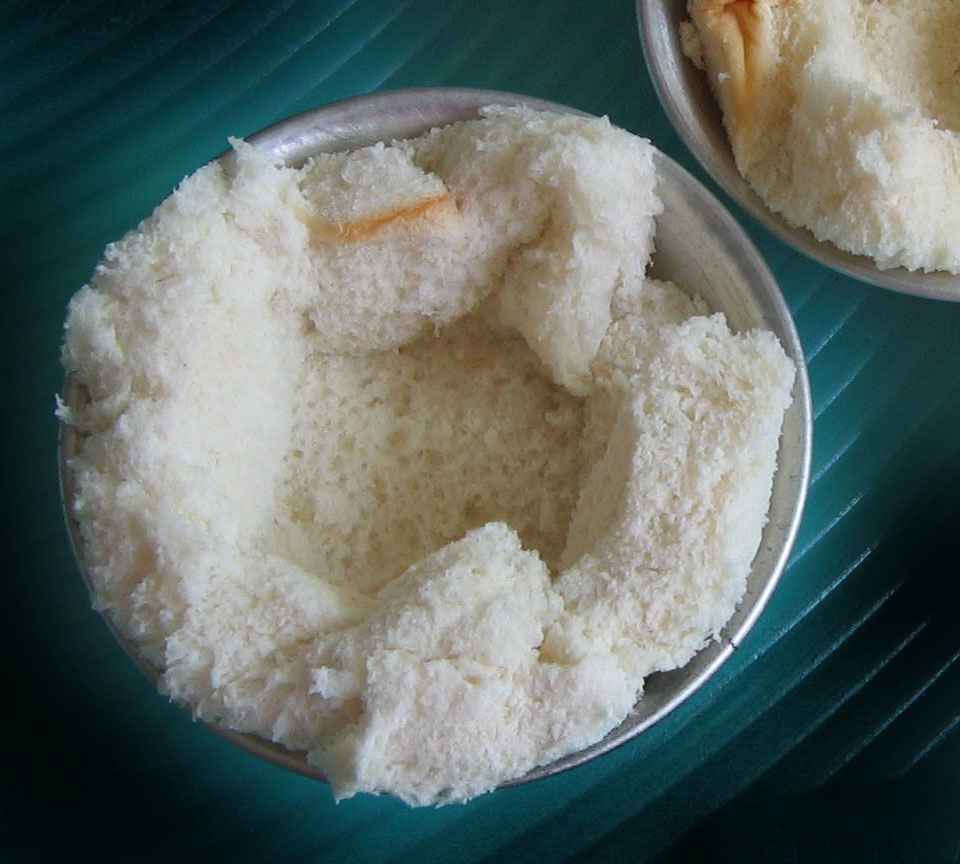
Trim sides of bread slices. Reserve the sides for later.


Flatten bread slices with your fingers or using a rolling pin. Press into ramekins/muffin cups. (One slice goes nicely into one ramekin.)

You may opt to toast the bread at this point, or leave the bread un-toasted then spoon-in the tuna-egg salad.

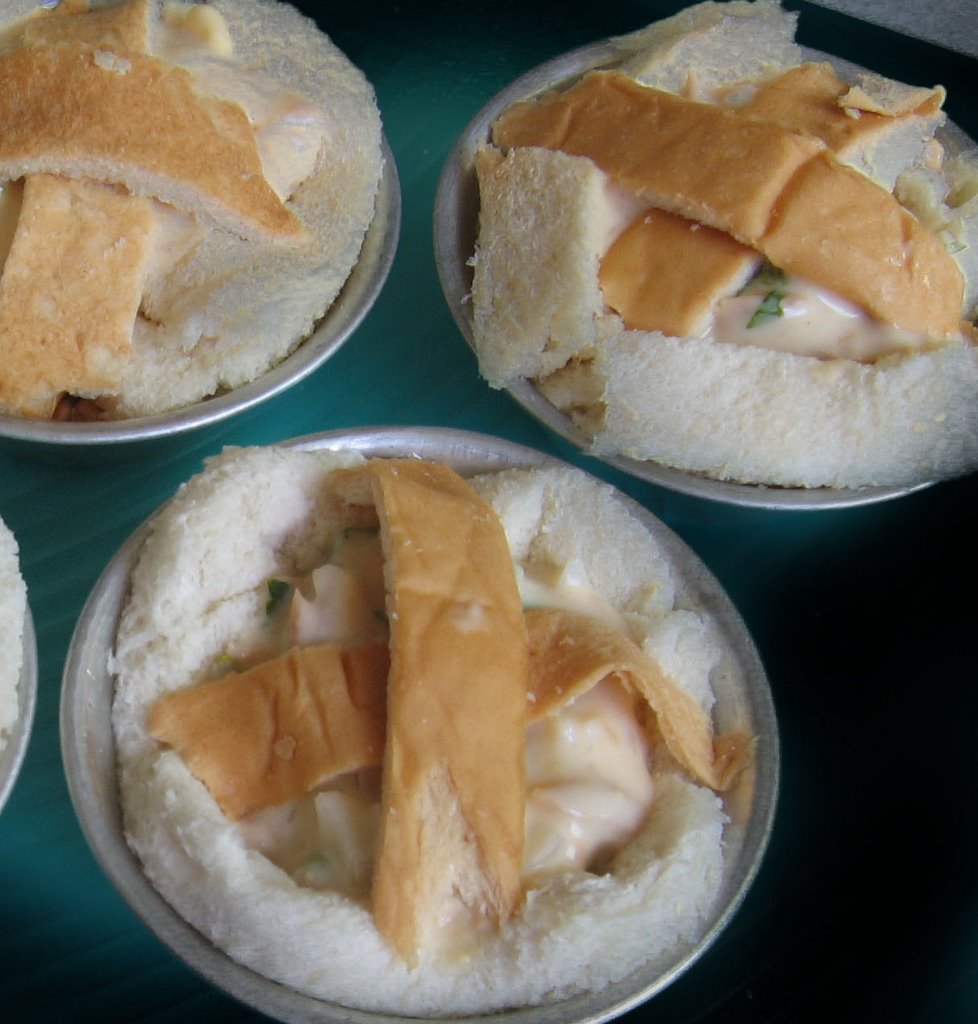
Top with the bread sides in a criss-cross fashion, then bake in an oven toaster for 5 minutes, or until the tops are golden brown.


Apr 1, 2006

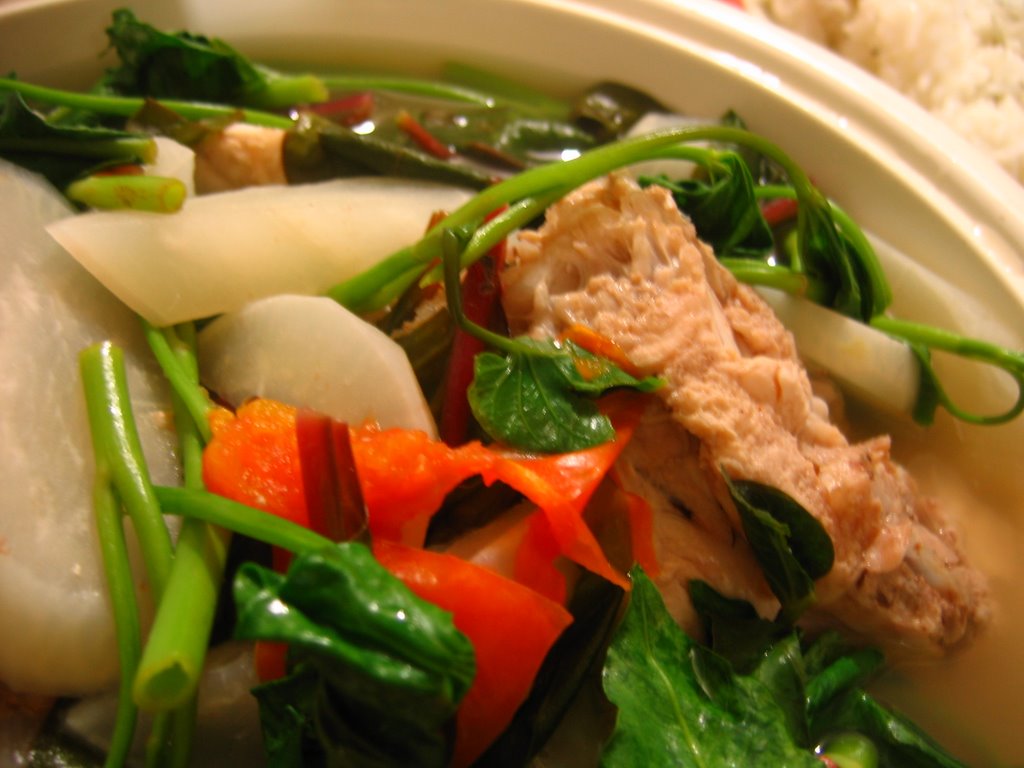
Sinigang na Ulo

It miraculously rained on Thursday; like God was saying, "Fret not, I'm still in charge here," as a reply to my incessant "Ang lamiiig naman dito sa Pilipinas!"

Anyhow, to celebrate that little rain and the unexpected reprieve from the summer heat, I decided to make broth that night. Nothing's heartier than soup when it's a rainy night.

Also, since the soup is hearty, we have a reason to skip rice. (Yehey!) Also, since Mike and I made a quick stopover at his suki at the palengke in Pacita and he bought a truckload of fish again, including the whole head of a maya-maya, I made Sinigang na Ulo.

I really don't think you need the recipe, but if you do, here it is. :)

Sinigang na Ulo
(Fish Head Sour Soup)

What's In It?
1 big head of Maya-maya (Snapper), about 1kg, cleaned and chopped
1 large onion, peeled and quartered
2 large native tomatoes, quartered
2 bundles kangkong (swamp cabbage), washed, leaves separated from stalks
1 large radish, peeled and sliced
juice from 5-7 pieces calamansi (Philippine lemon)
3-5 tablespoons patis (fish sauce); or to taste
1 liter water or rice washing

Kitchen Conjugations
In a large pot, boil the water/rice washing with the quartered onions and tomatoes. When the water gets to a rolling boil, add in the fish head and the radish and allow to boil until the radish is half-cooked (semi-translucent). Pour in patis and calamansi juice and boil until the radish is cooked. Check seasonings. Add in kangkong, allow to boil for 30 seconds (or to crisp-tenderness) then remove pot from heat.

PS
1. Use the water from the second time of washing rice grains if you opt to use rice washing. The soup gets more flavorful (malinamnam).

2. You can use tamarind instead of calamansi, but for fish soups I always use calamansi to remove the fishy-ness (lansa).

3. You can also use Knorr Sinigang sa Calamansi. If you opt to, make sure to pour in the mix long before you add the fish and other ingredients, to make sure that you cook the artificial ingredients in the mix long enough without overcooking the fish and/or veggies.

Mar 16, 2006

Sneaky Mom's Nuggets

I'm a sneaky mom.

Whenever I can, I sneak health into my kids' meals. I add chopped carrots into spaghetti meat sauce; I put minced banana blossoms into burger patties (oh yes!) and there are disguised chopped greens when I make meatballs. I do many other things besides that, in the pursuit of healthy eating.

This recipe is another sneaky tactic.

Gambel doesn't like fish; he likes chicken. And horrors, he doesn't eat the flesh, preferring the crispylicious skin. (He won't eat chicken cooked any other way than fried. If I serve tinola, he'd just have the broth.)

One time at McDonald's though, he got curious about the Chicken Nuggets I was eating and snagged one bite. To my surprise, he liked it and ate the rest of my meal. Aha...so he would eat chicken meat that way pala. Ting! (Idea bulb flash!)

So for dinner one time I decided to make nuggets, and decided to push my luck further by using Tanigue (Spanish Mackerel) slices (which I later deboned and cut into nuggets). To aid the disguise, I served gravy on the side.

I know the guise worked when both my boys ran down the stairs excitedly saying, "I smell chicken!" and ate with gusto. The guise was perfect until JAM discovered a fragment of fishbone in one of his nuggets and declared, "Ay, mommy alam ko na ito..." I had to flash him a meaningful glare so as not to reveal my sneaky secret to Gambel...

Anyhow, we've had Sneaky Nuggets for three or so times more since then, with Gambel still having no clue of this fishy deal.

SNEAKY NUGGETS

What's in it:

1 kg fish fillets (Tanigue, Blue Marlin or Lapu-Lapu), cut into nuggets
2 eggs, beaten with 2 tablespoons water
2 packs McCormick Fish Nuggets breading mix
cooking oil for deep frying (about 2 cups)

Kitchen Conjugations:

1. Heat cooking oil in a deep pan.
2. Dip the fish nuggets in the beaten egg mixture, then coat evenly with the breading mix.
3. Fry in hot oil for 3 minutes, or until the coating turns golden brown. (Do not overcook, as the fish will lose all juice and harden.)
4. Serve with Mang Tomas gravy, tomato catsup or sweet chili sauce.

Mar 14, 2006

Arranque Adventure a.k.a. Something Fishy

I like going to Arranque Market (in Sta. Cruz, Manila), and we go there every Sunday when we can. I enjoy each trip because, as Bryant puts it, "It's like being in a Hong Kong Wet Market--only that you understand what people are saying!" :P

It's like being in a Hong Kong market because Arranque is a treasure trove of chinese vegetables, fresh fruits, herbs and spices and the fish varieties one doesn't find in town markets. Finding so many food items gets me excited with the kitchen possibilities. :P

Last Sunday, as usual, I bought a week's menu -- I bought Polonchay, watercress, spinach and Kai-Lan or Gai-Lan (Chinese Broccoli) and Wan Soy (Coriander). I also bought some tofu, tokwa, tausi and ngo-hiong (Five Spice) and chinese Fish Balls for Tom Yum or Fish Ball Soup, whichever I later fancy.

And as usual, we bought some 3 kilos of sweet, juicy, creamy caimito (star apple), my summer favorite.

Something Fishy

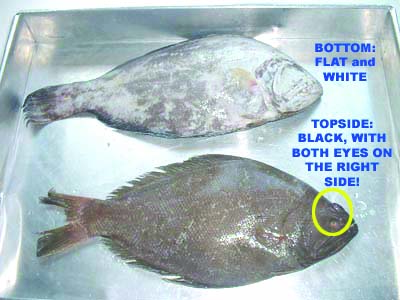
From the fish section we bought Espada, Dapa, some giant squid and a kilo of Halaan (Clams). As we waited while the fish was cleaned and sliced, I asked aloud "Ano sa English 'yung Espada? Swordfish?"

Mike answered, "Hindi. 'Yung Swordfish, matulis at mahaba ang nguso." (I was a fish ignoramus before I met Mike, familiar only with Bangus, Tilapia, Hasa-hasa, Salay-salay, Dalagang Bukid and the lowly galunggong. It was Mike who acquainted me with the bigger varieties-- Lapu-Lapu, Labahita, Talakitok, Tanigue... so on. So I had to take his word for the Swordfish thing.)

Yet his fish familiarity aside, we were at a loss for a translation for Espada and Dapa. Writing this blog I was tempted to say "we bought Quasi-Swordfish and some Get-Down." Tee-hee-hee. :P

Uncomfortable as I am with ignorance, I researched and found that Dapa is actually the local term for all fishes that are flat, but that there are 7 families of flatfishes, with over 540 separate species. (More info: Market Manila.) I learned later that what we bought is known in English as Indian Halibut.

Then as it turns out, Mike is right about the difference between Swordfish and Espada. Espada in English is Cutlass Fish (the silvery variety) and Black Scabbard (the black variety, predominant in Madeira islands, wherever that is... ) For our education I'm posting both pics -- the Swordfish at left, and the Cutlass, at right. :)

Anyhow, I made Halaan Soup for lunch (shellfish is best cooked fresh), and we had the Dapa/Halibut for dinner. Recipes follow. :)

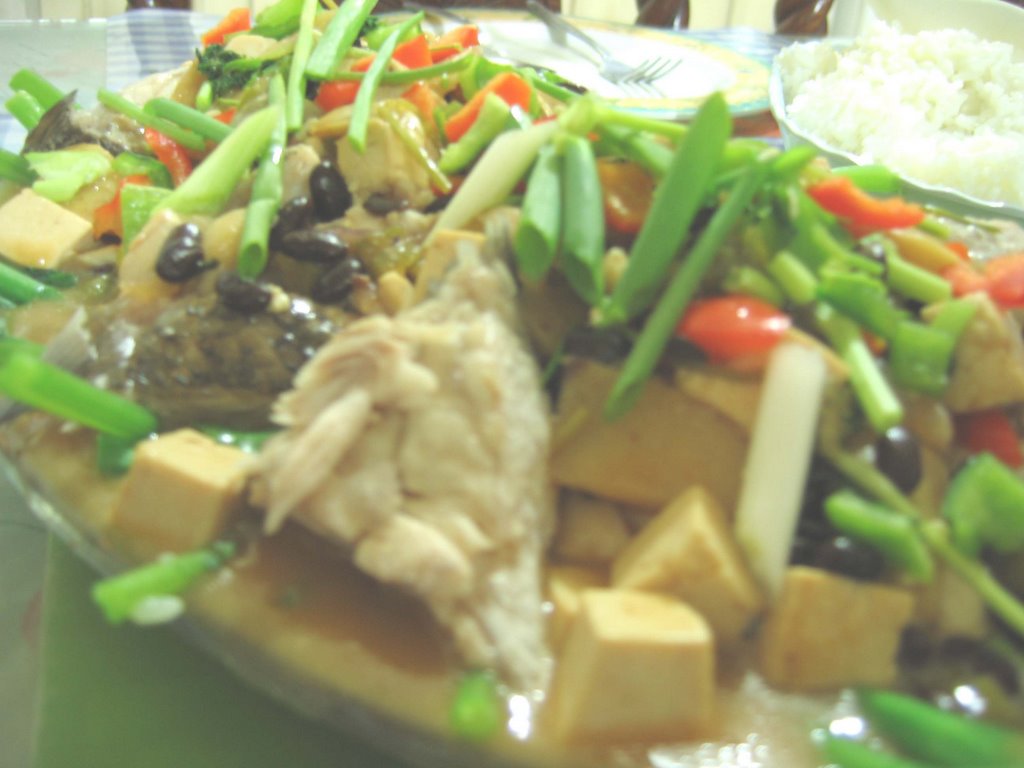
Steamed Halibut with Tausi, Tofu and Kai-Lan

First, the tips and notes.

This dish is composed of 3 steps -- steaming the fish, making the sauce, and blanching the Kai-Lan leaves. To simplify, you could opt to cook this dish while you cook rice, as I did. I piled up the Kai-Lan in the rice pot as the rice was on its final stage of steaming. That way, the vitamins from the Kai-Lan steeped onto the cooking rice, I cut one step and saved on LPG. :)

You could also opt to deep fry the fish instead of steaming it, but steaming is the healthier option. :) Also, as I did in this recipe, you can use some of the water in the steamer pot (which has the fish drippings collected from steaming) for the sauce. This way, you still get the important Omega 3 and fish oil in, and not waste water! :)

Steaming will take about 10-15 minutes. You can use that time for slicing and preparing the sauce ingredients.

I used olive oil for sauteing, but that's because I am watching our cholesterol levels. If palm oil is what you have in the house, by all means use it!

And now, the recipe.

What's in it?

1 Indian Halibut (Dapa), about 1.5 kgs., cleaned and sliced
4 cups tap water
3 tablespoons olive oil, or canola oil
1 thumb ginger, sliced
5 cloves garlic, minced
1 small onion, sliced
1 small red bell pepper, sliced into small cubes
1 small green bell pepper, sliced into small cubes
3 to 4 tablespoons tausi (salted black beans)
2 to 3 tablespoons brown sugar
1 block tofu, sliced into cubes
1 1/2 tablespoons cornstarch dissolved in 2 teaspoons water
spring onions cut into 1/2" lengths for garnish
half a bundle of Kai-Lan, washed and separated into individual stalks

Kitchen Conjugations:

Boil water in a steamer pot (or a wok). Brush fish slices with a little oil then arrange them on the steaming plates (or grill, if using a wok). Cover and steam for 10 minutes or so.

Meanwhile, blanch kai-lan leaves (by arranging them in a bowl and pouring boiling water on them; or follow my suggestion above). Do not overcook; they should still be a little crunchy and green. Remove from heat and arrange on serving platter. Set aside.

Prep-up sauce ingredients. [If you're done with that, go watch TV or something. :)]

If fish is cooked, remove steaming pot from heat, and carefully transfer the fish slices from the steamer plates onto the bed of Kai-Lan leaves.

Heat olive oil in a pan and saute ginger, onions and garlic for one minute. Add tausi, sugar and the bell pepper cubes and stir fry for 30-45 seconds. Add in tofu, stir fry for half a minute, then add 2 to 3 cups of fish stock (from the steam pot) or water. Simmer for about a minute, then check seasonings. (If mixture has become too salty, add a teaspoon of vinegar and let simmer for 20 seconds more.) Add in cornstarch mixture and continue simmering and stirring until sauce thickens.

Pour sauce over fish slices and garnish with spring onions. Enjoy with steamed rice or batard (if you've given up eating rice) or wheat bread. And some White. Hehehe. :P