Jul 26, 2007

Sweet Basil Squid

Mike and I, we love seafood. As you (would) probably notice, most of the recipes (and food reviews) here (will) feature prawns, squid and fish.

We also love spice. And herbs. Me, I am crazy about basil. Given a choice I will always have pesto (proof: here). I sprinkle dried basil on my pasta each time we eat at Sbarro, and I will always find an excuse to put it in stir-fries whenever possible.

I love that its smell and flavor are interestingly indescribable. There's no way to say in a few words how it specifically smells or tastes. This is because the aroma and flavor of basil is an interplay of the essential oils present in its leaves: cinnamate (same as in cinnamon), citronellol (geraniums, roses, and citronella), geraniol (as in geranium), linalool (a flowery scent also in coriander), methyl chavicol (which gives tarragon its scent), myrcene (bay, myrcia), pinene (which is, as the name implies, the chemical which gives pine oil its scent) and ocimene terpineol. (Wikipedia) There's simply no way a dish will be bland with basil in it!

There's also quite a number of basil varieties, but the most commonly known and available is sweet basil. (This is also the kind commonly used in Thai, Indonesian and Vietnamese cooking.) I usually find Sweet Basil in the fresh produce section of Shopwise and SaveMore, with 100grams costing less than P20.00. (When they're in season, of course.) What an inexpensive way to put a little kick in your cuisine!

SWEET BASIL SQUID

What's In It?

  • 1 kg. squid, cleaned, ink sacs and backbones removed, body cut into rings
  • 1 large scallion/onion, peeled and sliced
  • 5 cloves garlic, peeled and minced
  • 3 pieces red pepper (siling labuyo), sliced - optional
  • 2 tablespoons cooking oil
  • 5 tablespoons oyster sauce
  • a bunch of sweet basil, leaves removed from stalks and washed well
  • some leeks, sliced diagonally into rings, for garnish

Kitchen Conjugations:

In a wok over high heat, saute onions and garlic in oil for one minute. Add in squid heads and rings, siling labuyo (if using) and oyster sauce. Stir fry for a minute then add in sweet basil leaves. Stir fry a few seconds more, just to cook the leaves a little*. Adjust and correct seasonings by adding a pinch of salt or sugar.

Garnish with leeks. Serve while hot.

NOTES:

  1. If you overcook the basil the leaves will turn black and leak all the essential oils into your food. The flavor will be very strong.
  2. Squid becomes hard and rubbery when overcooked, so cook it over high heat quickly.

Substitutions: You can use Thai Basil for the sweet basil, other meats like pork, beef, shrimps and chicken (see at left) for the squid. Prolong stir-frying to about 3 minutes if using pork, beef or chicken, but only 1 minute for shrimps.


Jul 22, 2007

Ginataang Santol


Every now and then -- no, make that most of the time -- I have difficulty producing good shots for this blog. You see, I usually cook for dinner and dinner happens, well, at night. The lighting isn't really the best, and I'm not (yet) very familiar with the flash settings of my cam. Add to that the fatigue from really long days... the picture above is an example of one of my wanting shots.


Ginataang Santol. Would you call it exotic? When I was 14 we had some visiting seminarians over for lunch and my lola served this dish. One of our guests asked what it was (he had trouble placing the taste) and I jokingly answered, "Ginataang Cactus." He looked so bewildered -- his tongue was saying it was good and okay, but his mind was telling him otherwise, so I told him right away it was santol before he could barf and ruin lunch for the rest of us. :)

Santol isn't exactly the stuff your usual ulam is made of. If you like some excitement and tang in your ulam I bet you'd like this, paired with crispy fried fish (tilapia, galunggong...) And I'm proud to say I'm the first ever (half) Bicolana to post it! Yay! Now would you be the first non-Bicolanos to cook it? :)

The recipe is how I recall it from weekends watching my lola's cooking.

GINATAANG SANTOL

What's In It?

3-4 pcs. Santol
4 cups coconut milk
1 scallion/onion, peeled and sliced
5 cloves garlic, peeled and minced
3 teaspoons salt or 3 teaspoons raw bagoong alamang
3-5 pcs. siling labuyo

Kitchen Conjugations:

Peel santol. Cut in halves, remove the seeds and set aside. Dice pulp. Sprinkle about 1/2 teaspoon salt over the diced santol, mix then pick up handfuls of the diced pulp and squeeze to remove some of the juice. (This is so the dish does not go sour beyond edibility. Hahaha.)

In a deep pan heat coconut milk, onions and garlic, stirring every now and then to avoid curdling. When the mixture boils, add in santol and salt (or alamang). Continue stirring slowly until the mixture boils. Add in siling labuyo and let the mix simmer until the coco milk is thick and reduced, about 15 minutes.

Serve with steamed rice and fried fish.

Jul 18, 2007

Lemon Grass Meatballs


We usually joke that to the unknowing, we can be considered weird because we have pots of grasses in our garden. But hey, no, we're not actual potheads -- just people who love some lemon grass - or tanglad-- every now and then.

(Our lemon grass are potted because we just carried them over from when we were renting, and back then all our plants were potted for better portability.)

I made Lumpiang Shanghai and after a few dozen rolls, ran out of lumpia wrapper. What to do with the excess lumpia mix? Well, meatballs of course! I stuck in lemon grass stalks, courtesy of our potted-tanglad-garden, for interest. Okay, di ba?

Jul 5, 2007

Callos


The theme of Lasang Pinoy's 19th edition -- Barrio Fiesta: Eat 'Til You Drop is the essence of the fiesta as I knew it, growing up. The feasting didn't just happen for a day -- the fiesta, the food and the merrymaking lasted for days, at least in our home.

How so?

The fiesta in our parish, The Holy Family, happens every last Sunday of the year. Before that, the following things happen: three birthdays -- my brother's, Dad's and mine (8,18 and 24) and Christmas Day. The parish fiesta usually falls somewhere from the 26th to the 29th. After that, the food-laden table on New Year's Eve and more eating on New Year's Day. (And a few days after that, my mom's birthday on the 4th.) Did you count? Eight days of eating.

And so you'd probably understand when I say it's pretty hard to remember whether there was exactly a dish we prepared especially for the fiesta. :)

Anyway, since the fiesta was practically sandwiched in between special holidays punctuated by non-stop cooking and eating, it has become a peculiar custom among us neighbors to make the fiesta a leftover potluck day. Long tables are laid out on the street and each household brings out something to share, usually leftover from Christmas day. The table gets lined with various versions of macaroni salad and/or spaghetti bolognese, laneras of leche flan and loads of ham. From time to time some lechon/lechon paksiw, morcon or festive-looking bread breaks the predictability and disappear fast from the long table.

My Callos was one such hit. :)


Thanks to the wonders of pressure-cooking, making Callos is no longer as tedious and time-consuming as it used to be. And because ox tripe and ox legs (cow's pata) are readily available from the meat section of major supermarkets, you need not wait for a fiesta to taste or serve it. :)

CALLOS

What's In It?

1 1/2 kilos beef tripe (tuwalya)
1 1/2 kilos ox leg (have the butcher chop it into 4 large chunks)
2 T garlic, minced
2 pcs. medium-sized onion, sliced
3 pcs. red bell pepper, sliced and seeded
1 kilo fresh tomatoes, blanched, peeled and sliced
1 cup grated quick-melt cheese
1/2 cup hot sauce
1 cup chick peas (garbanzos)
1 large potato, peeled and sliced into thick strips
3 pcs. Chorizo de Bilbao, sliced diagonally
1 large carrot, peeled and sliced into thick strips
4-6 bay leaves
5 teaspoons fish sauce
1/2 teaspoon pepper
pitted green olives (optional)

Wash ox leg and tripe. Boil in enough water for 30 minutes, then discard the stock*. Replace water (enough to cover the meats) and cook in a pressure cooker. The meats should be under pressure** for no more than 20 minutes. Remove from fire and let cool for 10 minutes. Check pressure by raising one of the vents. If no steam comes out it is safe to open the pressure cooker.

Remove meats from the pot. Chop tripe into rectangular strips. Remove the softened ligaments from the bones and chop into the same shape and size as the tripe. Reserve stock for later.
In a deep saucepot, saute garlic, onions and tomatoes in oil. Add bell peppers and tomatoes and saute for one more minute or until tomatoes have wilted. Add in tripe and ox ligaments. Season with fish sauce and ground pepper. Cover and let simmer for 10 minutes.
Add stock, chili sauce, potatoes, carrots and bay leaves. Simmer for 5-7 minutes or until the potatoes and carrots are fork-tender. Stir in grated cheese, let simmer for two minutes more. Remove from fire and garnish with olives if desired.

--------
Notes:

*This is so that the stock does not get masebo and yucky smelling.

**The pressure is on if the pressure cooker begins hissing. With some pressure cookers the vents actually lift a little and dance on their bolts like polka dancers. :)

Jul 4, 2007

Luk Yuen


My Luk Yuen staples: Deep Fried Tofu, Fish in Tausi, Beef with Kangkong and Bagoong, Bird's Nest soup and Tossed Rice Noodles. Worth the drive, worth the guilt, worth the little extra.

Jul 3, 2007

Bulanglang

Two Saturdays ago, faced with a disciplining issue, my friend Jeng came up with a punishment that's right on the money -- having the kids eat okra. "Oh My Gulay!" They must have sighed collectively. The boys squirmed in their seats, waiting for the axe, er, slime to fall, and the power of the okra was enough to make them promise to never misbehave again.

I was raised in a carnivorous household and I can count by my fingers the number of times we were admonished to eat vegetables. And mind you, vegetables basically meant upo (bottle gourd), kangkong (swamp cabbage), repolyo (cabbage), kalabasa (squash) and sitao (string beans) -- the kid-friendly, better-tasting kind. Yet, even then, in the rare occasions when I did eat these veggies, the servings were in such small bits or mashed and taken with lots of rice, or covered with tocino, or followed up with gulps of water. Drama, suspense, action.

I hated vegetables.

And so it is a big surprise to my mother-- and moreso, to me-- that now, 30+ years after, I am now an avid fan of vegetables. I crave them. I make menus around them. I bring them to potluck parties. I skip restaurants that do not serve them. I make salads out of ampalaya, fill broths with saluyot, even go to Antipolo for bulaklak ng katuray for ensalada. Drama, suspense, action.

I woke up one day loving vegetables.

And so, for the 18th edition of Lasang Pinoy, I am writing about my first-ever attempt at Bulanglang. Bulanglang is an Ilokano dish that contains the stuff vegetable haters' nightmares are made of: saluyot, okra, talbos ng sitao, bulaklak ng kalabasa. Cooking-- and enjoying--this dish is a testament that I've really come full circle. :)


What's In It?

1 medium-sized bangus (milkfish), cut daing-style (butterfly)
2 bunches talbos ng sitao
2 bunches saluyot leaves
2 bunches okra (ladyfingers)
2 bunches squash blossoms
2 bunches string beans
5 to 6 cups water
1 medium onion, peeled and sliced
1/4 cup bagoong balayan

Kitchen Conjugations:

Season bangus with 1 teaspoon salt then grill over charcoal until done. Remove from fire and set aside.

Wash vegetables carefully and thoroughly. Cut sitao into 3" segments, okra into halves, crosswise. Remove squash blossoms, sitao tops and saluyot leaves from their stalks. Set aside.

Boil water in a sauce pot over high heat. Add onions and bagoong balayan, let boil for a minute or so. Add in grilled bangus. Let boil for 2 to 3 minutes to allow the flavors of the fish to meld with the broth.

Carefully remove bangus from the pot and transfer to a serving bowl. Add in okra and sitao and let simmer for one and a half minutes or until the vegetables are crisp-tender.

Add in the rest of the ingredients. Let boil for another minute or until the greens are crisp tender. Remove from fire and serve topped with the grilled bangus.

Read about other veggie recipes posted by Pinoy Foobloggers in the Lasang Pinoy 18 roundup, here.

(Many, many thanks to my ageless, proudly-Ilokana friend Mama Norms who introduced this Bikolana/Tagalog to Bulanglang, and for sharing the recipe. Stay sexy. Mmmwah!)

Jun 27, 2007

Hong Tai Yang

We discovered Hong Tai Yang as we drove home from Binondo one Sunday, when we took a detour that led us to Macapagal Boulevard. We were wondering where we were going to have lunch; Macapagal Boulevard is dotted with restaurants but we were in search of something new, and so Seaside, Gerry's Grill and classmates were out of the question.

Hong Tai Yang's billboard beckoned : "Over a 100 food choices." Clearly it was a marketing jab but what the heck, we drove in and followed the arrows to the back end of the Hobbies of Asia compound.

To our surprise, the restaurant was bustling with diners. And there, a stride from the door is the buffet counter filled with quite a variety of shabu-shabu (hotpot) and grill ingredients -- dimsum, hakaw, meats and poultry (fresh and processed, including tocino and bacon), innards and other laman loob bordering on the exotic, fish and seafood, lots of greens and other veggies....

We had a choice from among chicken, satay (which I took) and sinigang (Mike's choice) for the hotpot broth. Half an hour later we have tried half a dozen "courses," using the Teriyaki, BBQ and other condiments available, then helped ourselves to the all-you-want ice cream and halo-halo. Hay, patay na naman ang diet!

When we asked for the bill, the waiter was profuse with tips: "'Pag pumunta po kayo dito dapat yung gutom talaga kayo, tapos 'wag n'yong bibiglain. Yung iba kasi nabibigla, ayun, nagsasawa agad. Sayang din ho kasi 'yung bayad n'yo."

Oh, okay!

Anyway, we did come back four times more (and better prepared) after that, with the kids, with mom (on Mothers' Day -- boy, was the place packed!) and some friends. The kids liked the idea of being allowed to cook their own food -- and the seemingly endless supply of ice cream. :)

Hong Tai Yang opens from 11 am to 11pm daily. Lunch buffet costs P360 per head; dinner P395 (excluding rice and drinks). Kids pay only half (except on holidays). The place gets really full on weekends and special occasions, so the best time to come would be for weekday lunch, or call in for reservations.

Hong Tai Yang is at the back end of the Hobbies of Asia compound, along Macapagal Boulevard. (The entrance to the compound comes right after the Blue Lotus Spa.) HTY's frontage faces the Senate Building and is on the same row as Susan the Cooking Diva's kitchen.

Jun 26, 2007

Tokneneng / Kwek-Kwek


This post is more than a month late for the 17th edition of Lasang Pinoy, thanks to my hiatus from blogging and bloghopping (I read the LP announcement just last night). I'm hoping the good people of LP will accept it anyway and include it in the (post) round-up.


Tokneneng is the baby version of Kwek-Kwek, boiled chicken eggs coated with orange-tinted batter commonly sold on the street. Tokneneng is made of boiled quail eggs. Both Kwek-kwek and Tokneneng are my boys' favorites, and today I decided to treat them to the hygienic version. (As most people know, Tokneneng and Kwek-kwek get additional flavor from the spraying of smoke, dust and other airborne elements from people and vehicles passing by as they sit on display on the karitons.)


TOKNENENG

What's In It?

24 pcs. quail eggs, hard-boiled and shells removed
1/2 cup all-purpose flour
1/2 cup cornstarch
1/2 tsp + 1 pinch iodized salt
a pinch or two of black pepper powder
a pinch of Maggi Magic Sarap (optional)
1/2 cup tap water
2-3 drops red food color
2-3 drops yellow food color
1/4 cup all-purpose flour (for dusting)
1 cup cooking oil (for frying)

Kitchen Conjugations:


1) In a shallow pan prepare and heat cooking oil over medium heat.

2) Meantime, stir in food color into water until you get the desired tint. (Tip: Go for a little darker because the shade will pale when combined with the starches.)

2) In a medium bowl combine 1/2 cup all-purpose flour, cornstarch, salt, pepper and Magic Sarap or MSG (if using). Gradually add-in colored water, pouring a little at a time as you beat the batter with slow strokes. Add in any remaining water until the batter is fluid but thick. (See picture above. PS - I ran out of red food color so the batter is yellow.)

3) Pour the extra 1/4 cup all-purpose flour into a plastic bag or container. Add in the shelled quail eggs, cover/seal and roll to coat. (This gives the batter something to cling on.)

4) Dunk the floured eggs into the batter. Pick up using two teaspoons (so that you can keep the eggs rolling and coating in the thick batter and keep them as round as possible) then pop into the hot oil.

5) Fry for a minute each side or until the batter sets. Remove with a slotted spoon and allow to cool and drain on a colander.

6) Serve with sweet-chili sauce or sweet and sour sauce (bottled versions available at supermarkets) or spiced vinegar (white vinegar with minced red onion and a sprinkling of ground black pepper and salt). Enjoy!


PS uli: Today's tokneneng, happening on a school day, figured in the boys' lunch box. To make sure the Toknenengs stay crisp and fresh, the sauce was stored separately, to be poured in just before eating. The extra sauce packs I take home and keep from our fastfood eat-outs came handy. :)

SOME TRIVIA:

1) A quail egg has 3 times more cholesterol than a chicken egg.

2) The chicken figurine in the picture above is a candlestick holder, part of a set I bought in 1997. Her partner, the rooster, fell into pieces after being thrown into the air by one of my nieces, who thought it was plastic and was a toy. They were samples for an export project, and I have not found a replacement for Mr. Rooster.

3) The Easter Eggs (at the background) I bought from the Custom Clay Shop factory in San Pedro, for P10.00 each (I think they sold for P120 each at the malls). Gambel accidentally broke one of the eggs yesterday when his kicking pad flew while practicing TKD.

Jun 16, 2007

Maki Mo 'To?

After my Spaghetti House craze came my Teriyaki Boy fad. But I didn't go bananas over the teriyaki -- I went there almost everyday for the California Maki and Futo Maki.

Sorry to cross your hopes, but nope, I am not infanticipating. This craving is strictly weirdo.
Shown here are the makis I ordered at Teriyaki Boy in Megamall, right when we took a break from my ninang dress adventure. Sorry if the photo leaves much to be desired -- there's only so much that can be done under poor lighting and with a camphone.


The makis, however, performed according to expectations.

Apr 11, 2007

Easter Eggs


So I'm back -- after 10 years. :) I've been back in the kitchen but haven't been as prolific as before, so I'm afraid my posts would still be not as frequent as they were. For now I'd like to share the "recipe" for easter egg dyes and how to paint easter eggs.

Of course it'd be a lot simpler to just buy chocolate eggs, or just fill up plastic eggs with goodies, but where's the fun in that? My kids and I spent 2 hours painting last Saturday-- 2 hours less of boredom and inactivity.

Easter Eggs

What's in it?

20 eggs - good for 4 kids/kids at heart (a child can paint 5 eggs and still be bitin!)
food colors: red, blue, yellow, green, orange, violet, pink... you get the drift. :)
tap water
white vinegar


Kitchen Conjugations:

For the eggs:
1. Put eggs in a saucepan and add water, to level that's just enough to cover all the eggs.
2. Bring water to a gentle boil (use medium heat)
3. When water boils, throw in 1/2 t salt (to prevent the eggshells from cracking)
4. Let the eggs boil for 4 minutes.
5. Remove eggs from saucepan and transfer to a deep dish with water. Let cool for half an hour.
6. Remove eggs from waterbath and air dry or wipe with cloth.


For the egg dyes:
Combine 2 teaspoons food color, half a cup of water and 2 teaspoons white vinegar in plastic cups.

To paint the eggs:

(Be sure to line the work area with old newspapers for easy clean-up afterwards.)

Plain, colored eggs - slowly drop the egg into the cup of egg dye. Remove after a minute at least. (Keep the egg longer in the dye if you want a darker shade of the color.) Remove with the use of 2 plastic spoons and lay on an egg tray to dry.

Color-Resist eggs - draw designs and shapes on the egg using crayons. Then slowly drop the egg into a food color cup of contrasting color and let it sit there for about a minute or longer for a darker shade. Remove with the use of 2 plastic spoons and lay on an egg tray to dry.

Double-shade eggs - follow directions for plain colored eggs. When the egg is dry, carefully lower half of the egg into a different-colored egg bath and hold it there for half a minute or more (depending on preferred shade).

Marbled eggs - follow directions for plain colored eggs, but apply new/different colors when the egg is almost dry, using sponges, brushes, etc.

Handpainted eggs -- follow directions for plain colored eggs, let dry then apply drawings (swirls, flowers, stripes, objects, etc.) using tools at hand.

Get adventurous, try mixing and matching . :)


Mar 13, 2007

A Bientot!

Feb 13, 2007

Tossed Rice Noodles


Call me weird, but I have "staple food" in the restaurants/food outlets I frequent. If it were a new restaurant I'd be adventurous and try new things, but if it were McDonald's I'd have nuggets and fries; Sbarro--Spinach and Mushroom Pizza and Spaghetti with Tomato Sauce; TOSH--Pesto with Grilled Chicken on Spaghetti; Teriyaki Boy--Agedashi Tofu, Yasai Itame and Futo Maki; and at Luk Yuen--Seafood Roll, Beef with Kangkong, Deepfried Tofu and Tossed Rice Noodles.

The first time I was served Tossed Rice Noodles (at Luk Yuen Magallanes), I was intrigued. It looked like a pale, Chinese version of our Pancit Malabon. I was skeptical, thinking it'd taste the way it looked.

I was wrong. The dish was an interesting interplay of flavors of char siu (chinese barbecue), chinese mushroom, sesame oil, shrimp and celery. I was hooked.

Since then I've tried to replicate the dish in my kitchen. The problem however, was finding char siu. So I substituted -- with smoked octopus (for the smoked, roast flavor) and bacon.

The result isn't an exact replica of the real thing, but close nonetheless and something worth the effort. :)

TOSSED RICE NOODLES

What's In It?

200g. Rice Noodles (Q Pancit Palabok)
1 egg
100g. honeycured bacon
50g. smoked octopus (optional)
100g. medium prawns, shelled and deveined
5-6 pcs. dried chinese mushroom, soaked, softened and cut into thin strips
1 small carrot, peeled and julienned
1 chayote fruit, peeled and julienned
1 small bell pepper, julienned
2 stalks celery, diced
1 large red onion, peeled and sliced
5 cloves garlic, minced
1/4 cup cooking oil
a pinch each of salt and pepper
5 teaspoons fish sauce

Kitchen Conjugations:

1. Soak rice noodles in tap water for 15 minutes.
2. Meantime, make a thin omelette of the egg. Remove from fire and cut into strips. Set aside.
3. Fry bacon into crisps, then cut into 1/2" strips.
4. Cook rice noodles in boiling water for 8 to 10 minutes or until tender. Drain and set aside.
5. Heat cooking oil in a wok or deep pan. Saute onions and garlic.
6. Stir in carrots, bell pepper, mushroom, chayote and celery. Season with a pinch each of salt and pepper. Stir fry for 30 seconds.
7. Add in cooked rice noodles. Season with fish sauce and stir fry for another 30 seconds.
8. Toss in egg strips, bacon and smoked octopus. Add a dash of sesame oil then stir fry for half a minute.
9. Garnish with toasted sesame seeds and minced green onions if desired. Serve hot.

Happy Eating! :)

Jan 29, 2007

Guyabano (Soursop)

Acquired tastes -- the hallmark of growing old. Once upon a time, I hated finding in my lunch box a jar of guyabano shake/juice which well-meaning mom made for me. Seven, eight years old, and your beverage world is all about Tang.

Thirty-three, and I find myself liking -- no, loving -- coffee. And green salads. And craving for vegetables. And yes, guyabano.

Guyabano, like its relative durian, is the caviar of fruits. You either love it or hate it. I'm on the love side now.


I shook with excitement when I saw it in the Carmona Public Market. I checked with the vendor if it could be eaten right away. When she said yes, I paid her P40.00 for my 750-gram treasure.

At home after snapping a few shots (just so I can tell you), I sliced the guyabano open, sprinkled one slice with a few grains of salt, then slipped away a few moments to salty-sweet-sour heaven.

Jan 25, 2007

Ginisang Munggo and Prinitong Bugyo

"Ano ho'ng tawag, diyan?"
"Bugyo. Flying fish."
"Ano ho'ng luto diyan?"
"Paksiw. Saka prito."
"Sige, pabili nga ho ng kalahati. Pero wag n'yong putulin yung nguso, para makita ng mga anak ko."

I do not trust myself with buying fish. Checking for freshness, what's good for what isn't exactly my forte, and so it is my husband who buys fish. But it isn't always that I see this fish at the wet market in Pacita Complex, and I knew the find would be news to my husband:

"Wow! Saan ka nakakuha niyan?"
"Sa Pacita. Ano'ng tawag sa inyo nito?"
"Bangsi. Flying fish yan e."
"Sabi nga sa akin."

And so he fried up the bugyo/bangsi/flying fish while I cooked up the monggo.

I remember the story of one classmate who, according to lore, sauteed monggo beans straight up -- sans pre-broiling-- and invented the first ever chunky Monggo Guisado. I heard of one story too where another beginner made ginisang monggo with what seemed like a balde (pail) of sabaw. And so while I trust you are all adept *kitcheners,* (kusineras -- hehehe) I'd have to post the recipe for those who need a tip or two.


Tip #1: To save on gas and to shorten cooking time, wash then soak monggo beans in water for at least 30 minutes before boiling. You can do the soaking in the same pot where you intend to boil the beans. (Better if you can soak for 2 to 3 hours prior.)

Tip #2: Boil the monggo beans to soften them before sauteeing. If you've soaked the beans for at least 30 minutes, boiling time would be about 15-20 minutes. The beans are soft if the seed coat separates from the seed.

Tip #3. Do NOT boil monggo seeds in your pressure cooker.

Tip #4. They MULTIPLY exponentially. So do not cook a lot unless you intend to eat monggo for one whole week or feed a whole baranggay. One cup (about P10.00) feeds 6 to 8.

Tip #5. To pre-boil the beans, use 4 cups of water for every cup of monggo beans.

Tip #6. The green ones work best. Although some swear by the yellow ones. As for me, the red variety is strictly for hopia. ;)


GINISANG MUNGGO

What's In It?

3 T cooking oil
1 large onion, peeled and sliced
1 medium ripe tomato, washed and sliced
5 cloves garlic, minced
1 cup (about 80 g.) green monggo, pre-boiled
50g. hibe (dried shrimps), optional
50g. pork pigue, diced*
2 to 3 pcs. tinapa (smoked fish), scaled and flaked
4 to 5 cups water
1 bunch ampalaya (bitter gourd) tops, washed, leaves separated from vines (optional)
patis (fish sauce) to taste

Kitchen Conjugations:

Heat oil in a wok or deep pan. Saute onions, garlic and tomatoes for one minute. Add in pork and stir fry until lightly browned. Stir in hibe, tinapa, pre-boiled monggo beans and patis. Cover and simmer for 5 minutes over low fire.

Add in water and let simmer for another 5 minutes to allow the ingredients to meld. Top with ampalata tops and let simmer for half a minute or until the leaves change color. Serve with fried fish and steamed rice.

---------
*or use 1 pork broth cube or 50 g. chicharon

Jan 22, 2007

Sinigang na Sugpo (Prawns in Sour Soup)


On our way back from Baguio on New Year's Eve we passed by a series of street vendors selling tiger prawns along the highway at Sison, Pangasinan. The prawns were really huge -- an outstretched piece measured 6 inches on the average. We stopped to ask and lo, a surprise -- we were told the prawns sell for only P450 a kilo! (Back in Manila Mike bought much smaller ones for P550 per kilo, so we actually exchanged surprised, incredulous glances when we heard the price!) My husband hastily bought two kilos, and I dreamed of making Prawns Thermidor for media noche.

When we got home many hours after we weighed the prawns in and found to our dismay that the pack was short of 500g or so. Talk about disappointment. Filipinos cheating fellows. Shame.
Mental note to self: Bring your own weighing scale the next time.

Anyhow, I was too tired and low bat (and much too much in a rush) that I didn't get to make Prawns Thermidor that night. I cooked half the bunch into Chili Butter Shrimp instead. Of course, if and when I get to make Prawns Thermidor, you'd see the recipe here.

The prawns you see up there were bought and cooked many months ago (on Easter Sunday in fact, the next one but a few months away). Ang layo ba ng segue? Hehehe. Sowee!

Sinigang na Sugpo (Prawns in Sour Soup)

What's In It?

500g. prawns or shrimp
6 to 8 cups rice washing or tap water
1 bunch sitao (string beans), cut into 2" lengths
1 to 2 pieces labanos (radish), peeled and sliced into half-inch wedges
2 bunches kangkong (swamp cabbage), leaves separated from stalks, washed
2 red onions, peeled and quartered
2 large ripe tomatoes, washed and quartered
1 knob ginger, peeled and sliced into rings
2 pcs green peppers (optional)
juice of 6 to 8 calamansi (Philippine lemon) or 1 sachet Knorr Sinigang sa Calamansi
1 1/2 t iodized salt or 1 T fish sauce

Kitchen Conjugations:

In a saucepan combine the ricewashing/water, onions, tomatoes, ginger and green pepper then heat to a rolling boil. Add in shrimps/prawns, radish and string bean slices and let boil for another two minutes or until the radish becomes translucent. Season with the salt/fish sauce, calamansi juice and simmer for 30 seconds, then add in kangkong leaves. Let simmer for 30 seconds or so, enough to blanch the leaves.

Serve while hot.

Jan 16, 2007

Pescado Grande with Tausi (Fish with Salted Black Beans)

I'M ALIVE!

After 10 years (tee-hee-hee), I'm back in blogging form. Not to spoil the surprise, but let me say there'd be changes in this blog soon, and this post will be among the few of the 'old school'. Let's enjoy it while it lasts. :)


First off for this year is a fish dish, payback for all the crimes committed during the holiday season. :)

Here's the fish: a fairly large one. As I write this, my husband is in China and isn't around to identify it for me, so for the moment let's call it Pescado Grande. :) We bought it at the Arranque Market for P250 per kilo, and I think it weighed in close to 2 kilos. That's a broadsheet newspaper it's lying on, and it occupied 2/3 of the sheet. Pretty big, huh?

Anyway, after the descaling and slicing into more manageable slices, Mike fried Pescado Grande and I took it from there. Recipe below. I'm scaling it down to a more manageable size for you who are not too much into fish eating. :)

FISH WITH SALTED BLACK BEANS

What's In It?

500g. to 800g. fried fish*
3-5 T cooking oil
2 T tausi (salted black beans)
3 T ginger, peeled and sliced into thin strips
1 red onion, sliced
5-6 cloves garlic, minced
1/2 c to 3/4 c water
3 -5 T brown sugar
3 t cornstarch dissolved in 5 t water

Kitchen Conjugations:

Lay fried fish/fish slices on a serving platter.

Heat cooking oil in a wok or frying pan. Saute ginger, onions and garlic until onions are translucent, about 2 minutes. Add tausi and stir fry for 30 seconds before adding water.
Let simmer for 3 minutes. Adjust seasonings by adding a pinch each of salt and pepper, then stir in cornstarch mixture. Let simmer for a minute or so or until the sauce thickens.

Pour over the fish slices and serve immediately. Garnish with chopped spring onions or wansoy if desired.

-----------
*Fried tilapia, labahita, bangus, dalagang bukid, bisugo, maya-maya will work just as well.

Dec 5, 2006

Chicken Teriyaki - Pinoy version

The word teriyaki is a combination of two Japanese words: teri, which means luster and yaki, which means grilled. Of all meats, chicken is the most commonly used for teriyaki, although the recipe works well with other meats like beef, pork and turkey, as well as fish and seafood.


My first taste of teriyaki was back in UP, from one of the outlets in CASAA. Back then though, owing perhaps to the constraints of affordability, time and effortlessness, CASAA teriyaki were not grilled but were stir-fried (quite like bulgogi) on flat, stove-top griddles. Instead of whole chicken thighs or breast cutlets we got strips. Back then too, a set of beef teriyaki with sauteed mongo sprouts and a cup of rice, takeout (that costs higher than dine-in because you pay for the styro pack) is a measly P24.00!

Ah, those were the days. All I had to think about was how to budget my baon and how to make it through my next Calculus exam!

But going back on track, here's my recipe for Teriyaki. A cross between the budget-conscious UP version I loved and the sosy version everybody loves.


What's In It?

2 chicken breasts, skinned, deboned and cut into bite-sized strips
1/3 c light soy sauce
1 T brown sugar
2 T corn oil
1 T vinegar
1/2 t ground ginger
1 clove garlic, minced

Kitchen Conjugations:

Combine the ingredients in a bowl and chill in the refrigerator overnight. Heat about 1 teaspoon of cooking oil in a wok then stir-fry the marinated meat for 2 minutes. Add a little of the marinade when the meat gets done and simmer for 2 minutes more.

Serve hot with sauteed mongo sprouts with steamed rice and a garnish of onion leek strips.

--------
How is this different from the authentic Japanese version? Well, that one uses mirin (sweet rice wine) and sake (rice wine). Here, those are substituted with vinegar balanced by the brown sugar. And since this is stir-fried, you can easily make it in the morning for school or office baon.

Ginataang Kalabasa at Sitaw (Squash and String Beans in Coconut Milk)

Checking my site stats I was surprised to find out that many people have landed on my site in their search for a recipe of Ginataang Kalabasa and Sitaw. I thought nothing of it back in October, thinking that perhaps many Filipinos were simply looking for what to do with the flesh of carved pumpkins/squash used for halloween. But guess what, it's almost Christmas but "ginataang kalabasa" still figures prominently in my site's keyword activity! Strange, but true.

Anyways, I've been honored by a request from starlightjulian, who asked for an English version of the recipe I posted in August (I posted in Filipino, in commemoration of Filipino Language Month). Here it is, enjoy!


GINATAANG KALABASA AT SITAW (Squash and String Beans in Coco Milk)


What's In It?
  • 2 squash segments , washed well and cut into cubes (leave unpeeled)
  • 1 bunch string beans, cut into 2" portions
  • 1 medium sized onion, peeled and quartered
  • 1 knob ginger, peeled, sliced and pounded
  • 1 head garlic, peeled and pounded
  • 3-5 pieces chili (use less or none at all if spice is an issue!)
  • 6 to 8 cups canned/instant coco milk, or freshly squeezed from 1 large coconut, or 2 medium ones
  • 100 grams pork fat (optional)
  • dried anchovies or shrimp fry (optional)
  • salt, according to taste

Kitchen Conjugations:

Follow package directions to make instant coco milk. If using fresh coconut, pour one cup lukewarm water over coco meat and leave for 1 minute. Add about 4 cups of tap water to moisten all of the coco meat. Take a handful or two of the moist coco meat, squeeze it between your hands, catching the coco milk with a strainer over a deep bowl or the saucepan you will use for cooking.

Add in the onions, garlic and ginger and the pork fat (if using) and heat the mixture over medium fire, stirring continuously to prevent curdling. (Use left to right slow sweeping motions to introduce motion into the mixture without unnecessarily dissipating heat and allow the mixture to boil.)

When mixture boils, add in the squash and allow to boil, stirring from time to time until the squash is half-cooked. Add in string beans and chili (if using) and simmer until the beans sweat and changes color. Season with salt and sprinkle with smoke fish flakes, dried anchovies or shrimps if desired. (If you're brave enough go ahead and crush the chili on the sides of the pan and stir back into the mixture.)

Best served hot with steamed rice and crispy fried fish.

Pasta Negra


Since sampling Pasta Negra at The Old Spaghetti House I've been wanting to make a go for my own version, but I haven't had luck finding squid ink pasta in Shopwise or SaveMore. Last Saturday, as I was cleaning some giant squids my husband brought home from the weekend market, one of the ink sacs burst and gave me a "try and see" opportunity. First, to see whether I can blacken regular spaghetti by adding some of the ink to cooked spaghetti and then to see whether I can make savory squid ink sauce without the lansa.


I failed the first test. The spaghetti didn't blacken. Maybe I should've added the ink to the water during cooking, before adding the pasta, to give the spaghetti enough chance to absorb the blackened water.

I passed the second challenge however. The sauce wasn't malansa. Yipee. The secret? Check out the recipe:

Pasta Negra (Squid Ink Spaghetti)

What's In It?
250 g. spaghetti, cooked according to package directions/until al dente

3 T olive oil

5 cloves garlic, minced

1 large onion, minced

250 g. squid, sacs removed and ink reserved, sliced into rings or bite sized pieces

2 packs 250g Clara Ole Mushroom Spaghetti Sauce

1/4 c cooking wine or white wine*

1.5 t iodized salt

1.5 t ground black pepper

1/2 t dried basil leaves (or rosemary)

Kitchen Conjugations:

In a saucepan heat oil then saute onions and garlic for one and a half minutes or until onions are soft. Turn up heat then add in squid, stir frying for 30 seconds, then stir in salt and pepper and (cooking) wine. Let simmer for 30 seconds then add in spaghetti sauce and squid ink, then leave to simmer for 2 minutes. Sprinkle dried herbs and let simmer for 30 seconds more, then adjust seasonings as necessary.

Stir in cooked pasta and toss to coat. Serve with garlic toast (and a glass of chilled Riesling, Chablis or Sauvignon Blanc. Hehehe).

Would have been great for Halloween, and what shrieks would have been if the tentacles suddenly moved on their own just as you were digging in! :)

-----
*You may also use Mirin, Sake with a little sugar, some beer, or whatever wine you have available AND enjoy drinking.

Dec 1, 2006

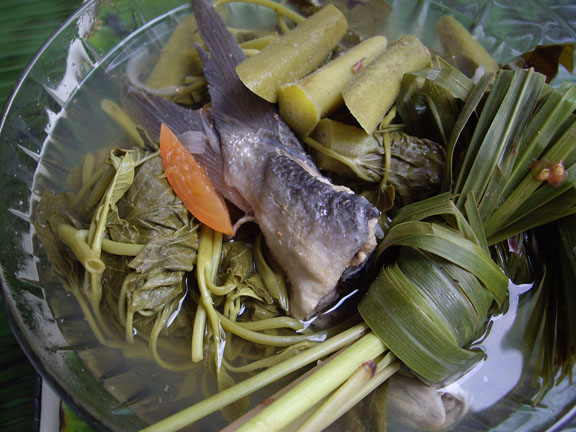
Sinigang na Bangus with Tanglad


Rainy and windy (albeit stormy) weather is always good for one thing -- hot broths. Bulalo would have been nice, but my, the cholesterol! So we opted for Sinigang na Bangus.

As in all broths and stocks, the best flavor comes from the bony parts -- the bone marrow makes bulalo savory, the buto-buto or ribs makes Sinigang na Baboy flavorful. For fish sinigang, well, I believe the head and the tail are the best parts. (Reserve the belly for frying. Make it crisp and wow -- you've got the best combination!)

Anyhow, I discovered SeaKing's Bangus head and tails pack in Shopwise. The pack, which costs P30.00 max, is all head and tails, 500 grams. Throw in some veggies and you have soup for 8! Great, di ba? The tanglad was thrown in for flavor, but go ahead without it and you'd be okay. :)

SINIGANG NA BANGUS WITH TANGLAD

What's In It?

500 g. Bangus, head and tails

1 teaspoon salt

1 large red onion, peeled and quartered

1 large or 2 medium ripe tomatoes, quartered

1 knob ginger, peeled and sliced diagonally

juice of 8 calamansi or 1 pack Knorr Sinigang sa Calamansi mix

1 bunch tanglad (lemongrass), about 8 stalks

8 to 10 cups rice washing, or tap water

2 bunches kangkong, leaves separated from stalks

1 bundle okra, sliced diagonally into 2" pieces

2 teaspoons salt or fish sauce

Kitchen Conjugations:

Wash head and tails and season with 1 teaspoon salt. Set aside.

In a saucepan, boil water/rice washings with the onions, ginger, tomatoes and tanglad. Add in okra and fish when water comes to a rolling boil. Simmer for 2 minutes then season with calamansi and salt or fish sauce. Simmer for another 2 minutes, then add in kangkong. Leave to boil for another minute then remove from heat. Adjust seasonings if necessary, then serve.

Tanglad is usually removed before serving, but I always leave it in for drama. :)